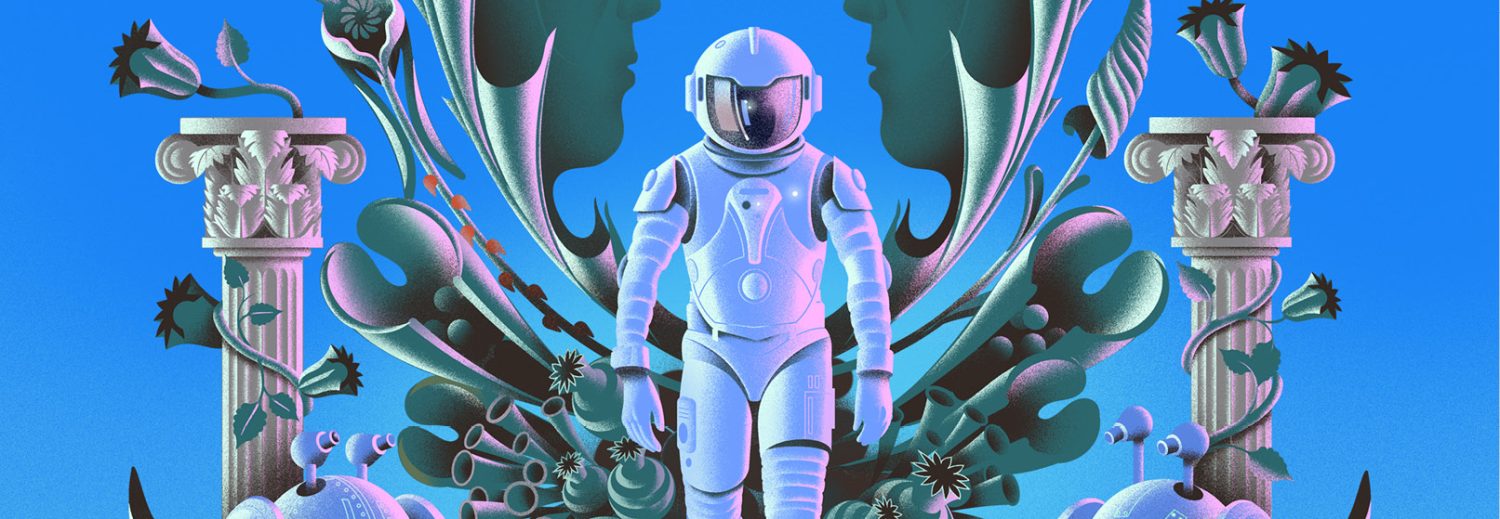
This week’s BookBrunch interview is with one of my favourite new authors from the past year, Vic James. If you haven’t got your mitts on a copy of her fantastic debut novel Gilded Cage yet, you absolutely should, and for those of you who need more convincing, here’s an interview with the author herself…
 Author Vic James is instantly likeable. She’s earnest, friendly and a little bashful, but it soon becomes clear she’s also got a mind like a rapier and a devastatingly on point turn-of-phrase. Her debut novel Gilded Cage, the first book in The Dark Gifts trilogy, garnered over 300,000 readers on Wattpad, sold for a six-figure sum to Pan Macmillan and has been auctioned in six territories and counting. We got together to discuss the real Wattpad society, magical aristocrats, and how fiction can shed light on Britain’s structural inequality.
“People have the idea that Wattpad is this monolithic thing and that people who want to be published authors use it, but that’s not my experience,” James says. Though there are some who use Wattpad to try to “get discovered”, and many of its users are young teenage writers for whom the platform is a learning process, mostly “it’s just there for people to have fun”. Nine in 10 of Wattpad’s 40 million users are just readers, nothing more, many of them from countries with a poor public library system or where they don’t have the money to buy books. It’s huge in the Philippines, for instance.
Continue reading “The BookBrunch interview with Vic James, author of Gilded Cage”
 The big book buzz this week has been about the 2016 BBC National Short Story Competition winner, KJ Orr, and her winning story, ‘Disappearances’. A debut author, Orr beat a heavyweight shortlist including Man Booker winner Hilary Mantel and Costa Poetry Award shortlisted Lavinia Greenlaw. Here, Orr discusses what it feels like to have won, how she came across short stories, and their value to readers.
 The Guardian‘s Gary Younge has been undertaking serious investigative journalism since the mid-nineties, exemplified more than ever in his latest book, Another Day in the Death of America. Here, we discuss the book, how he researched it, how journalism has changed over the past two decades, and what that means for storytelling
 Comedian Sara Pascoe sits in a room at the Faber offices surrounded by piles of her new book, Animal: The Autobiography of a Female Body. She speaks quickly, as if each of her thoughts are eager to be expressed first, and uses her hands expressively to illustrate her points.